


There is a quiet trap that catches a lot of TEAS 7 candidates. They find a popular question set, drill it until they can recite the answers in their sleep, walk into the testing center expecting to see those exact items, and then meet a version of the exam that shares almost none of them. The panic that follows is entirely avoidable, and it comes down to one fact most people learn too late: the TEAS 7 is not a single fixed test. It exists as several interchangeable forms that get cycled through the testing calendar.
This changes how you should study. If the specific questions you memorize are unlikely to reappear, then memorizing questions is the wrong target. The right target is flexible, transferable understanding of the underlying concepts, which shows up no matter which form you draw. This guide explains how the forms work, why the exam feels so different from person to person, and how to build the kind of knowledge that holds up against randomness. If you would rather learn by doing, the practice quizzes at TestPrep TEAS are designed to train concepts rather than rote answers.
What "Multiple Forms" Actually Means for Your Exam
Ask two people who took the TEAS in the same month what their Science section looked like, and you will often get two very different answers. One will tell you it was mostly anatomy and physiology with a handful of chemistry items. Another will swear their version barely touched anatomy at all. Both are telling the truth, because they sat different forms of the same exam.
A test taker who scored a 90 described exactly this. On his version the Science section leaned heavily on the scientific method, with roughly ten anatomy and physiology questions, about ten chemistry questions, and the remainder spread across other topics. He was upfront that he felt he had drawn one of the easier forms, and he estimated the odds of any two people getting the identical version as roughly one in eleven. Whether or not that exact ratio holds, the takeaway is sound: your experience is one sample from a rotating pool, and you cannot predict which sample you will get.
There is a second layer of randomization on top of the forms themselves. Even within the practice materials, the composition of questions changes each time you take a practice exam. The same student noticed that some of his practice attempts pulled a few questions that resembled his flashcards or prep materials, other attempts pulled none, and still others pulled similar questions with different wording and numbers. If the practice engine shuffles that aggressively, the real exam is no more predictable.
The practical consequence is simple. Betting that you will see the same questions you studied is a losing strategy. You have to prepare to answer questions you have never seen before, on topics you can recognize but whose exact framing is a surprise.
Why Memorizing Question Banks Backfires
Rote memorization feels productive because it produces a satisfying sense of mastery. You see a card, you know the answer instantly, and your brain rewards you. The problem is that this kind of recall is brittle. It attaches to the specific wording of a specific item rather than to the concept underneath, so when the wording changes, the recall collapses.
On a randomized exam, the wording always changes. A question you could answer flawlessly in flashcard form gets rephrased, embedded in a scenario, or paired with different answer choices, and suddenly the memorized response does not fit. The student who scored a 90 saw this play out. When he compared his prep materials to the actual test, he found only a small handful of items that were extremely similar, and even fewer that matched word for word. He recalled maybe one that was identical. The rest tested the same knowledge dressed up differently.
That does not mean question banks are worthless. Used correctly, they are one of the best review tools available, but for a different reason than most people assume. Their value is not that you will see those exact questions again. Their value is that they force you to retrieve knowledge you already have and shake the rust off information you learned long ago. The same student described his flashcard sets as an overarching review that helped him recall old knowledge so it was easier to summon on exam day. That is the correct way to think about them: a memory-refresher, not a preview of the test.
The Strategy That Actually Works: Target Your Weak Areas
If you cannot predict which questions appear, you optimize for coverage of your weakest ground. This is the single most repeated piece of advice from high scorers, and it is the opposite of comfort-zone studying.
Most people gravitate toward the topics they already know because reviewing them feels good and confirms competence. That is wasted time on a randomized exam. If you are already comfortable in an area, the odds are strong that you will handle whatever version of it appears, so every extra hour spent there earns you very little. The hours that move your score are the ones you spend on the material that scares you.
The 90-scorer built his entire approach around this. He took and retook practice exams for the express purpose of identifying his strengths and weaknesses, then poured almost all of his limited time into his weakest area. In his case that was chemistry, because he had never taken a college chemistry course and remembered little from high school. He was already solid in anatomy, physiology, and biology, so he largely left those alone and hammered the chemistry until it was no longer a liability. He reasoned that if a form happened to be chemistry-heavy, he needed to be ready for the worst case rather than hoping for the best case.
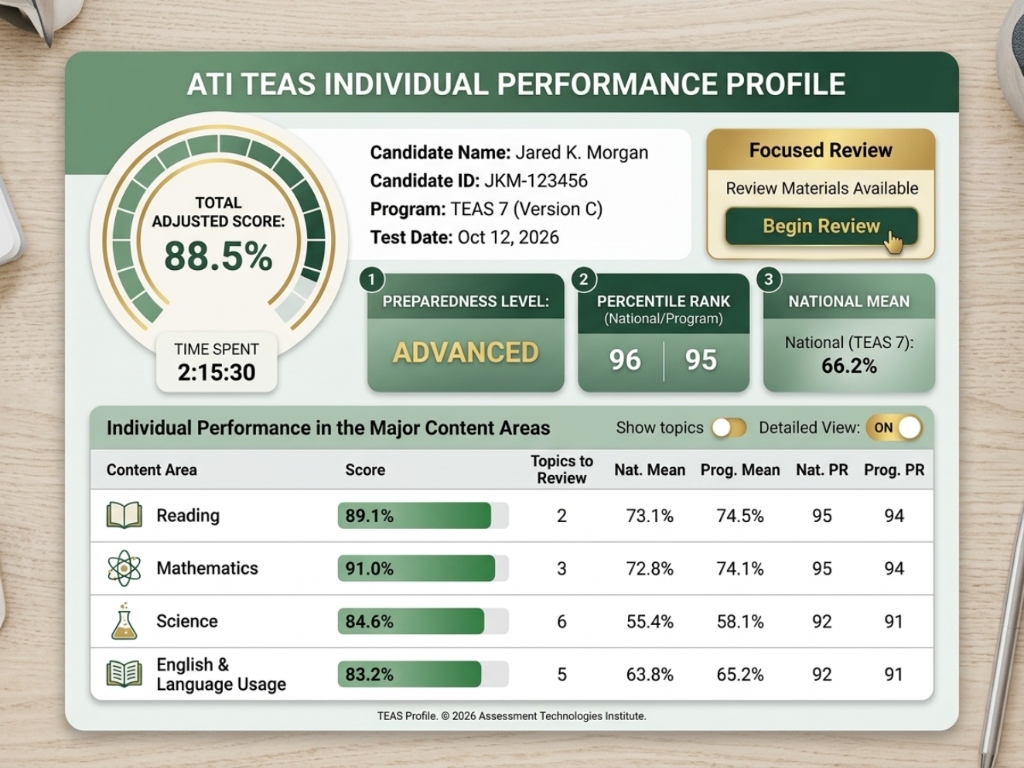
This is why a good diagnostic is the foundation of any smart TEAS plan. You cannot target your weak areas until you know what they are, and self-assessment is notoriously unreliable. Take a full practice run across all four sections before you build your plan, let the results tell you where you actually stand, and then aim your effort accordingly. The TestPrep TEAS practice quizzes are built to surface exactly those weak spots so you are not guessing about where to focus.
How to Use Practice Tests as a Diagnostic Engine
Practice tests are most powerful when you treat them as measurement instruments rather than as content to be memorized. The workflow is straightforward and it repeats.
Start by taking a practice exam cold, without cramming beforehand, so the result reflects your true baseline rather than short-term memory. Review every question you missed, and more importantly, understand why you missed it. There is a meaningful difference between missing a question because you did not know the concept and missing it because you rushed, misread the instructions, or copied a number down incorrectly. The 90-scorer noticed that many of his math errors on practice runs were not knowledge gaps at all. They came from hurrying and from transcribing figures wrong, which told him his fix was slowing down and checking details rather than relearning math.
Once you have a clear picture of your gaps, study those specific topics, then take another practice exam to confirm the gap has closed. Because good prep systems point you toward the specific lessons tied to your weak areas after a practice run, you get a built-in study list rather than a vague instruction to review everything. Work through those targeted lessons, retest, and repeat the cycle. Each pass narrows the distance between where you are and where you need to be, and because you are always working on your current weakest point, no effort is wasted.
Section-by-Section: What to Expect Across Forms
While the exact questions vary by form, the underlying skill areas are consistent. Here is a realistic picture of each section based on what recent test takers reported, so you know what to prepare for regardless of which version you draw.
Science
Science is the section where form-to-form variation is most noticeable, which is precisely why breadth matters. One person may get a heavy dose of anatomy and physiology while another gets a scientific-method-heavy version with a roughly even split between anatomy and chemistry. Because you cannot know in advance, you need functional competence across the whole range: the scientific method and experimental design, core anatomy and physiology across the major body systems, foundational biology such as cells and genetics, and enough basic chemistry to handle a cluster of questions if your form happens to lean that way.
Chemistry deserves special attention precisely because it is the area most people neglect. Candidates who never took a college chemistry course routinely name it as their weakest link, and a form that happens to be chemistry-heavy can wreck an otherwise strong score. You do not need deep expertise, but you do need the fundamentals solid enough that a chemistry-loaded version does not blindside you.
Mathematics
The math section frequently surprises people by being more approachable than the practice materials suggested. Much of it is familiar ground from high school and earlier college coursework that simply needs dusting off: conversions, geometry, and setting up and solving algebraic equations were all common on recent forms. The recurring lesson from high scorers is that math mistakes are usually not knowledge failures but speed failures. Slowing down, reading the instructions fully, and double-checking that you transcribed the numbers correctly eliminates most of the errors that quietly cost points here.
Reading
Reading tends to involve a modest number of passages, often only a few, most of them a handful of paragraphs long, followed by standalone question sets. The skill it measures is careful comprehension under mild time pressure. Because the passages themselves are unique to each form, there is nothing to memorize; the only real preparation is doing enough reading practice that the question types feel familiar and you trust your first careful read rather than second-guessing it.
English and Language Usage
English is heavily weighted toward grammar mechanics: sentence structure, punctuation, and spelling come up repeatedly. This is good news for a randomized-exam strategy, because grammar rules are finite and transferable. Once you internalize the rules, they apply to any sentence the exam throws at you, regardless of form. A few focused practice sets are usually enough to make this section feel routine.
A Study Plan Built for a Randomized Exam
Pulling the pieces together, here is a plan designed specifically for an exam you cannot predict.
Begin with a full diagnostic across all four sections before studying anything, so you measure your true starting point. Rank your sections from weakest to strongest based on the results, not on how you feel about them. Commit the majority of your study time to your two weakest areas, and for many people one of those will be chemistry within the Science section. Give your strong areas only light maintenance, since they are already likely to survive whatever form appears.
Use question banks and flashcards as recall tools, not as answer keys to memorize. Their job is to shake loose knowledge you already have and to expose concepts you are shaky on, so that when a rephrased version appears on the real exam, the underlying idea is fresh. Convert flashcards into multiple-choice form where you can, since practicing in the format of the actual test builds the retrieval pattern you will need. Between study blocks, retake practice exams to confirm your weak areas are actually improving, and adjust your focus as the picture changes.
Above all, internalize the mindset that carries randomized-exam takers through: you are not preparing to recognize specific questions, you are preparing to answer any reasonable question on each topic. That shift, from memorization to genuine understanding, is what separates people who are rattled by an unfamiliar form from people who barely notice which version they got. Build that flexible foundation with the TestPrep TEAS practice quizzes, which train concepts across every section.
Test-Day Mindset When You Do Not Know Your Form
Walking into the testing center not knowing which version awaits you can feel unnerving, but the right mindset turns that uncertainty into a non-issue. The people who perform best are not the ones who guessed their form correctly. They are the ones who prepared broadly enough that the form does not matter, and who stay composed enough to apply what they know.
Remind yourself before you start that the exam tests fundamentals, not obscure trivia. If you have done the work of covering your weak areas, the knowledge you need is already in your head, and your job is simply to retrieve it calmly. The student who scored a 90 went in on very little sleep, expecting the worst, and found that his brain produced knowledge he thought he had forgotten. That is what a solid foundation does under pressure: it holds even when your nerves are telling you it will not.
Manage your pace deliberately. On math, the most common source of lost points is rushing and copying figures incorrectly, so slow down and verify each step. On reading, trust your first careful interpretation instead of talking yourself out of it. On science, if you hit a cluster of questions from your weakest topic, do not spiral. You prepared for exactly this scenario by focusing your study there, so lean on that preparation.
If your form turns out to be an easier one, take the gift without letting your guard down. If it turns out to be a harder one, remember that the scoring accounts for difficulty and that everyone drawing that form faces the same challenge. Either way, the version you receive is out of your control, and the only thing worth spending energy on is answering the question in front of you as well as you can.
Common Mistakes That Sink TEAS 7 Scores
A few predictable errors trip up otherwise well-prepared candidates, and every one of them is avoidable once you are aware of it.
The first is comfort-zone studying, spending hours reviewing material you already know because it feels reassuring. On a randomized exam this is almost pure waste, since your strong areas will likely take care of themselves. The second is treating flashcards as a crystal ball, expecting the memorized questions to reappear and being thrown when they do not. The third is neglecting chemistry because it feels hard, only to draw a form that leans on it. The fourth is rushing the math and losing points to transcription slips rather than genuine gaps. The fifth is over-studying the night before at the expense of sleep, which degrades exactly the recall you need. Guard against these five and you eliminate most of the self-inflicted damage that separates a mediocre score from a strong one.
Frequently Asked Questions About TEAS 7 Forms
Does the ATI TEAS 7 really have multiple versions? Yes. The exam draws from a rotating pool of forms, so the specific questions and the balance of topics can differ significantly from one test taker to the next. This is why two people who test in the same window often describe very different exams.
Will I see the same questions I studied on flashcards? Almost certainly not in the same form. High scorers consistently report seeing only a small handful of items that closely resemble their prep, and very few that match word for word. Flashcards are best used to refresh knowledge you already have rather than as a preview of the test.
Which TEAS 7 section varies the most between forms? Science tends to show the most variation. One version may be heavy on anatomy and physiology while another leans on the scientific method or chemistry. Because you cannot predict the mix, broad coverage of all Science topics is essential.
What is the smartest way to study for a randomized exam? Take a diagnostic practice test, identify your weakest areas, and pour most of your time into them while giving your strong areas only light review. Focus on understanding concepts rather than memorizing specific questions, since the wording will change.
Is chemistry important for the TEAS 7 Science section? It can be. Some forms include a notable cluster of chemistry questions, and candidates who skip it because they find it difficult are the ones most likely to be caught off guard. You do not need advanced chemistry, but you should be comfortable with the fundamentals.
Final Word
The TEAS 7 rewards adaptability, not memorization. The moment you accept that you cannot predict your form, your whole strategy sharpens: diagnose your weaknesses honestly, attack them relentlessly, use practice questions to refresh rather than to memorize, and build understanding deep enough to survive any rephrasing. Do that, and it stops mattering which of the many versions you draw, because you will be ready for all of them.
Start by finding out where you actually stand with the free practice quizzes at TestPrep TEAS, then aim your effort where it counts. You are more prepared than your nerves are telling you.