


Every year, thousands of nursing hopefuls convince themselves that a passing TEAS 7 score is locked behind an expensive study package. It is not. Students clear the exam with strong scores every single test cycle using library books, free videos, and a modest set of practice questions. The exam rewards focused preparation far more than it rewards spending.
This guide pulls together what actually worked for people who took the ATI TEAS 7 recently and passed. It covers each of the four sections, the specific topics that showed up on real exams, the mindset that separates a good score from a borderline one, and a realistic study plan you can follow without draining your bank account. If you want to skip straight to practicing, the free practice quizzes at TestPrep TEAS are the fastest way to see where you stand.
What Is the ATI TEAS 7 and Why Does It Matter
The Test of Essential Academic Skills, now in its seventh edition, is the standardized entrance exam most nursing programs use to screen applicants. If you are applying to an Associate Degree in Nursing, a Bachelor of Science in Nursing, or an Accelerated BSN (ABSN) program, your TEAS 7 score is usually one of the first numbers an admissions committee looks at.
The exam is entirely multiple choice. It covers four sections: Reading, Mathematics, Science, and English and Language Usage. Most programs care most about your Science score and your overall composite, since Science tends to be the hardest section and the strongest predictor of how you will handle the anatomy and physiology coursework ahead.
A score in the low-to-mid 80s puts you in a competitive range for most programs. Break into the 90s and you are near the top of the applicant pool. Both of those outcomes are reachable without a premium package.
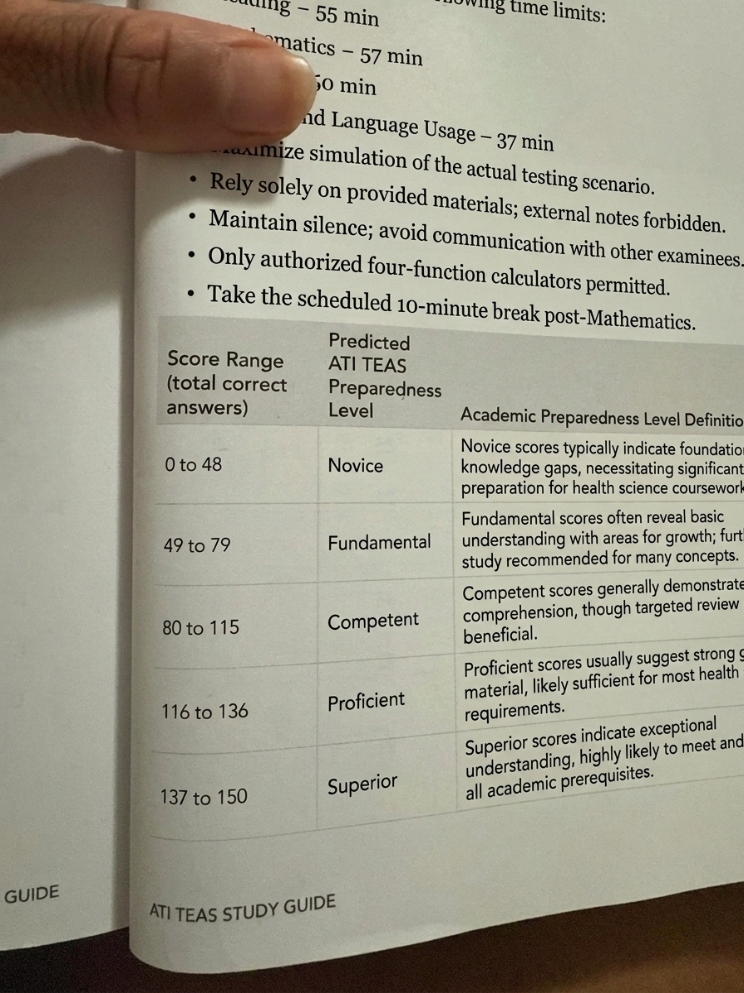
ATI TEAS 7 Section Time Limits
To manage your pace on the test, it is vital to know the exact timeline for each portion of the exam:
- Reading: 55 minutes
- Mathematics: 57 minutes
- Science: 50 minutes
- English and Language Usage: 37 minutes
Predicted ATI TEAS Preparedness Levels & Score Ranges
Understanding where your score places you is key to determining if you need to retake the exam or if you are ready to apply. Below is the official breakdown of score ranges, correct answers, and preparedness levels:
| Score Range (Correct Answers) | Preparedness Level | Academic Preparedness Level Definition |
|---|---|---|
| 0 to 48 | Novice | Novice scores typically indicate foundational knowledge gaps, necessitating significant preparation for health science coursework. |
| 49 to 79 | Fundamental | Fundamental scores often reveal basic understanding with areas for growth; further study recommended for many concepts. |
| 80 to 115 | Competent | Competent scores generally demonstrate comprehension, though targeted review beneficial. |
| 116 to 136 | Proficient | Proficient scores usually suggest strong grasp of material, likely sufficient for most health requirements. |
| 137 to 150 | Superior | Superior scores indicate exceptional understanding, highly likely to meet and exceed all academic prerequisites. |
The Core Truth: You Do Not Need a Premium Study Package
Here is the single most repeated piece of advice from students who have passed: save your money. One test-taker who scored in the 97th percentile in the country studied for roughly a week using only practice quizzes, and she was just a few weeks into her first Anatomy and Physiology course at the time. She estimated that at least a quarter of the exact questions she saw on the exam appeared on her practice quizzes, and the rest tested the same information written a slightly different way. That was specifically for the Science section, which is the one everyone worries about most.
Another student ordered an inexpensive used study guide off Amazon, supplemented it with free YouTube videos made specifically for the exam, and passed with far better scores than she expected. Her verdict on the pricey packages was blunt: an expensive bundle sounds like a scam when you can prepare with a library book and free video.
The pattern is consistent. People who over-invested in comprehensive guides often found the material went deeper than the exam required. One student stopped using a heavier commercial guide midway through because it started covering topics she recognized from actual nursing school coursework, material that has no business slowing you down before you have even been admitted. For the TEAS 7 you need the basics done well, not graduate-level depth.
So before you spend anything, understand what your money should and should not buy. A small amount spent on quality practice questions is worth it. A large amount spent on an exhaustive guide that teaches you nursing-school content is not.
Where to Find Affordable and Free TEAS 7 Resources
You have more free and low-cost options than the ad-driven corners of the internet want you to believe.
Your local public library or school library almost certainly has TEAS study books on the shelf. Borrow one before you buy anything. Used study guides on resale sites frequently cost a fraction of a new copy, and the content barely changes edition to edition for the fundamentals you need.
Free video instruction is abundant and genuinely good. Students consistently point to YouTube channels dedicated to TEAS prep for clear explanations of the science, math shortcuts, and English rules. If you have not taken chemistry in years, a general high-school chemistry video series can rebuild the basics faster than reading a dense textbook chapter. The same goes for biology walkthroughs that focus on cells, systems, and genetics.
And then there is practice. Nothing else moves your score the way repeated practice questions do. Working through realistic questions, checking your answers, and understanding why you missed the ones you missed is the highest-return activity in your entire study plan. You can start right now with the free practice quizzes at TestPrep TEAS, which are built to mirror the format and difficulty of the real TEAS 7.
Section-by-Section Breakdown of the TEAS 7
The following breakdown is built from what students actually reported seeing on recent exams. Use it as a targeting map so you spend your limited time on the topics most likely to appear.
Reading
The Reading section is a test of careful attention more than a test of vocabulary. Passages vary in length. A long passage may carry anywhere from two to six questions, while a short passage might have only one. You will see practical texts too, not just literary or academic ones. One student was given a recipe and asked about chronological order and who the recipe was intended for.
Expect questions on sequence of events, interpreting the meaning of words in context, identifying the purpose of a passage, locating supporting details and supporting arguments, finding the main idea, distinguishing opinion from fact from bias, recognizing the theme, and drawing inferences. Know the parts of a book cold, because they show up: the difference between a glossary, an index, an appendix, a table of contents, and a thesaurus, and where information like the copyright appears. Compare-and-contrast questions round out the section.
The best advice for Reading is behavioral, not academic. Take your time on the long passages. Read carefully, go with your first instinct, and resist the urge to second-guess yourself. This section is designed to trip you up when you overthink, so trust the read you did the first time. More than any study guide, doing a large volume of reading practice questions is what builds the pattern recognition you need here.
Mathematics
Many students are surprised by how manageable the Math section feels, and the reason is simple: you get an on-screen calculator. Use it on the basic arithmetic to save time and avoid careless slips, then reserve your mental energy for setting up the harder problems correctly.
The topics that appeared on recent exams include basic math, ordering numbers from least to greatest when they are mixed as decimals and fractions (convert the fractions to decimals to compare them quickly), and a range of word problems including fraction word problems and ratio word problems. Ratio questions are often easier than they look. If the question asks for the ratio of girls to boys, you simply read off how many of each there are.
You should also be ready for basic geometry involving pi, such as circumference and the area of a circle or a square, though the necessary conversions are typically provided to you. Beyond that, expect to solve for a variable, calculate mean, median, and mode, handle percentage word problems like a fifteen-percent discount, and interpret charts, including which type of chart best fits a given data set. Know the difference between positive and negative correlation, and be able to recognize distributions described as bimodal or uniform. You will also translate written phrases into mathematical expressions (for example, "five is less than twice a number") and distinguish independent from dependent variables.
The single highest-value habit in Math is to redo every calculation at least twice. A second pass catches the small errors that quietly cost you points. If your prep time is short, a quick brush-up on formulas and a lot of practice problems is usually all this section requires.
Science
Science is the section that decides most TEAS 7 outcomes, and it rewards breadth. The good news is that the depth required is modest as long as you cover the right topics.
Chemistry appears but lightly. Students reported only a handful of chemistry questions, on things like identifying the atomic number as the proton count, the triple point, and covalent bonding. You do not need to relearn an entire chemistry course. You need the fundamentals: states of matter, what a catalyst does (it speeds up a reaction), why water is such a good solvent (the polarity of its molecules), and how substances act as buffers by donating a hydrogen ion.
Biology and human anatomy and physiology carry the heaviest weight. Be ready to distinguish DNA, genes, and chromosomes; explain osmosis; and describe the function of a totipotent cell (it can develop into any cell type). Know your systems in functional terms rather than exhaustive detail. For the integumentary system, understand that melanin protects against ultraviolet radiation. For the endocrine system, know the major glands and hormones and which gland releases what, because this comes up repeatedly. For the reproductive system, know the timing of ovulation and when fertility peaks, and be able to trace the relevant pathways.
The cardiovascular system is a reliable source of questions: the pathway of blood through the heart, the pulmonary circuit and the difference between oxygenated and deoxygenated blood, and which vessels a myocardial infarction affects. The renal system shows up through the nephron pathway, the role of antidiuretic hormone, and the difference between afferent and efferent arterioles. From the nervous system, know its major parts and the approximate threshold value of a mammalian neuron. Immunology appears too, covering the function of plasma B cells and cytotoxic T cells and how cytokines let one immune cell activate another.
Round this out with a working knowledge of prokaryotes versus eukaryotes, the parts of a cell, Punnett squares and basic genetics, and the bone-remodeling roles of osteoblasts and osteoclasts in conditions like osteoporosis. A couple of cross-disciplinary science items can surface as well, such as an earthquake triggering a tsunami or the concept of terminal velocity.
The most effective Science strategy is to learn the material through practice questions rather than passive reading. Students who leaned on question banks reported recognizing the same information on the actual exam, sometimes worded almost identically. Study what you do not know, confirm what you do, and keep drilling the endocrine and cardiovascular material until it is automatic.
English and Language Usage
Several students called English the hardest section, usually because they under-prepared for it, assuming their everyday fluency would carry them. It will not. This section tests formal rules, and the rules are specific.
Cover grammar and punctuation thoroughly, including apostrophe placement, quotation-mark placement, and correct capitalization. Know how to spot a dangling modifier, tell a complex sentence from a compound one, and identify adverbs, adjectives, and prepositions. Be precise with commonly confused pairs: affect versus effect, who versus whom, and homophones versus homographs. Know correct spelling and the spelling rules that generate it, such as dropping the final "e," doubling a final consonant, and dropping the final "y" before certain endings. Understand prefixes and how they change meaning.
On the composition side, know point of view (first, second, and third person), how to choose the best topic for a paragraph, and how to identify the sentence that does not belong in a paragraph. Understand what makes a strong academic thesis statement, recognize formal versus informal language, and know the stages of the writing process. Finally, know when a citation is required, since that comes up more than most people expect.
Because this section is rule-heavy, flashcards and repetition work well. Turning the rules and confusing word pairs into a self-quiz format makes them far easier to memorize than reading them in a list.
A Realistic Study Plan on a Budget
You do not need months, and you do not need a big budget. Students have passed with strong scores after focused stretches of one to six weeks. Here is a framework you can adapt to whatever time you have.
Start with a diagnostic. Take a set of practice questions across all four sections before you study anything, so you know where you actually stand rather than where you assume you stand. The TestPrep TEAS practice quizzes are a fast way to get that baseline.
Then triage. Spend the majority of your time on Science, since it carries the most weight and the widest range of topics, and on whichever section your diagnostic exposed as your weakest. For many people that second area is English, precisely because it is easy to overestimate.
Learn primarily through practice, not passive reading. Work a block of questions, review every miss until you understand the underlying concept, and then move to the next block. Supplement the concepts you keep missing with a targeted free video rather than reading an entire chapter. Reserve light, quick review for Math and lean on the calculator during the exam.
In the final days, consolidate. Build a one-page sheet of the formulas, conversions, and high-frequency facts you want fresh in memory: the endocrine hormones, the pathway of blood through the heart, the pathway of urine through the kidney, meiosis versus mitosis, and the reproductive system. Many students write these down from memory the moment the exam begins, turning them into an instant reference sheet before the clock pressure sets in.
Test-Day Strategy That Protects Your Score
Preparation gets you to the testing center. Composure gets you the score. A few habits consistently separate students who perform to their ability from those who leave points on the table.
Breathe and slow down on Reading. The long passages are where careless speed does the most damage, so read them deliberately and trust your first interpretation. Second-guessing is the enemy in this section.
Check your math twice. Every calculation, even the ones that feel obvious, deserves a second look. The calculator makes this fast, so there is no excuse to skip it.
Dump your memory early. The moment you sit down, write out every formula, conversion, and mnemonic you have been holding, so you are not relying on a stressed brain to retrieve them mid-exam.
And keep perspective. This is a fundamentals exam, not a nursing-school final. You have prepared for the basics, the basics are what it tests, and you are ready for it.
Frequently Asked Questions About the TEAS 7
Do I really need an expensive study package to pass the TEAS 7? No. Students routinely pass with strong scores using library books, free videos, and a focused set of practice questions. The highest-return resource is quality practice, not an expensive comprehensive bundle, and heavier guides often go deeper than the exam requires. Start free with the TestPrep TEAS practice quizzes.
What is a good TEAS 7 score for nursing school? A composite in the low-to-mid 80s is competitive for most programs, and scores in the 90s place you near the top of the applicant pool. Requirements vary by school, so check the specific cutoff for the ABSN or BSN programs you are applying to.
Which TEAS 7 section is the hardest? It depends on your background, but Science carries the most weight and the widest range of topics, and many students find English surprisingly difficult because they under-prepare for it, assuming everyday fluency is enough.
How long should I study for the TEAS 7? There is no fixed answer, but students have passed with strong scores after focused preparation lasting anywhere from one to six weeks. What matters is targeted practice on your weak areas, not the total number of weeks.
Can I use a calculator on the TEAS 7 math section? Yes. An on-screen calculator is available, and you should use it on basic arithmetic to save time and avoid careless errors, then double-check every calculation.
Final Word
The most expensive part of the TEAS 7 is the mindset that you have to spend big to succeed. You do not. Borrow a book, watch the free explanations, and above all, practice relentlessly on realistic questions until the recurring topics feel automatic. Focus your energy on Science and on your weakest section, slow down on the long reading passages, and check your math twice.
You are capable of this. Prepare with intention, keep your money in your pocket, and walk into the testing center ready. Start building your score today with the free practice quizzes at TestPrep TEAS. Good luck. You have got this.